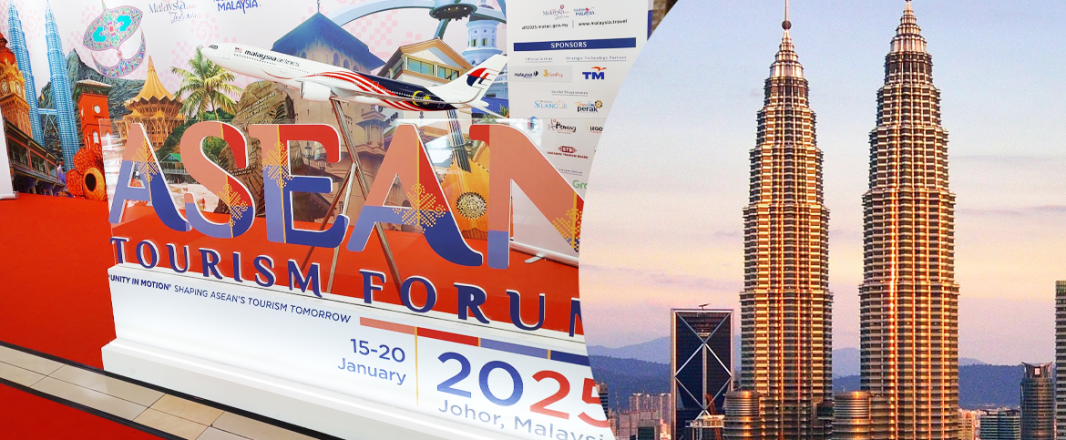
35.6 million and 147.1 billion. Keep these figures in mind as they are pivotal to Malaysia’s tourism industry as it gears up for Visit Malaysia 2026 (VM 2026). Simultaneously, the ASEAN Tourism Forum (ATF) 2025, held in Johor Bahru, Malaysia, from January 15 to 20, brought together over 1,000 delegates to shape the future of tourism in the region. Under the theme “Unity in Motion: Shaping ASEAN’s Tourism Tomorrow,” the event highlighted the importance of sustainability, innovation, and collaboration in fostering a thriving travel ecosystem.
Here’s where the numbers come in.
Malaysia used the ATF as a platform to promote its VM 2026 campaign, which aims to attract 35.6 million tourists and generate RM147.1 billion in tourism receipts. To reach these ambitious goals, the government has allocated a record-breaking RM550 million for tourism promotion, including extending visa-free access for Chinese and Indian tourists until the end of 2026.
For context, Tourism Malaysia is targeting 27.3 million foreign visitors and RM102.7 billion in revenue for 2024.
The math checks out. Via The Edge, Maybank Investment Bank noted that Malaysia’s tourism upcycle has begun, with related stocks such as Genting Malaysia Bhd, Pavilion Real Estate Investment Trust, and AirAsia X Bhd expected to benefit. Domestic tourism is also gaining importance, with local travel receipts exceeding RM85 billion in 2023. The Ministry of Transport highlighted improvements in air connectivity and aviation infrastructure as key drivers for the sector’s continued growth.
Sustainability and preservation to drive more authentic tourism
A core component of the forum was the ASEAN Tourism Conference, which platformed industry experts and players to speak on a number of issues, mainly Artificial Intelligence, sustainability and the evolving relationship between business owners and OTAs in the region.
Datuk Musa B. Yusof, Deputy Director General of Tourism Malaysia, stressed the significance of sustainability and technology in the future of ASEAN tourism. “Sustainability is no longer an option, it is a necessity to meet the expectations of today’s travellers, who are increasingly conscious of their environmental and cultural footprints,” he said.
One initiative to boost sustainability seems to be the promotion of smaller towns, hidden gems and more authentic experiences. “Undertourism is a problem in Malaysia, especially in sleepy hollows and small towns,” said Justine Vaz, Executive Director, The Habitat Foundation, during her session called ‘Sustainability Pioneers: Malaysian SMEs Driving Change. She added, “There are tourist attractions hiding in plain sight; new tourism destinations and potential UNESCO locations to be discovered.”

A sustainability-driven panel featuring (from left) Justine Vaz, Executive Director, The Habitat Foundation, Dr Wong Siew Te, CEO and Founder, Bornean Sun Bear Conservation Centre and Cher Chua-Lassalvy, Co-founder and Managing Director, Batu Batu
“Habitat opened in 2016, and we’ve been cash positive for a while now. Tourism plays a conservation function. Habitat’s stretch of park provides a protective barrier for the reserve, even from poachers,” Vaz explained.
The forum also highlighted growing concerns about overtourism in certain destinations such as Semporna in Sabah. “I think if you can produce experiences for people that are purpose driven and makes them feel good, it sells. Green is cool,” emphasised Cher Chua-Lassalvy, Co-founder and Managing Director of Batu Batu, a private island resort off the coast of Johor. Batu Batu maintains the island’s eco-balance by mapping the impact of occupancy on flora and fauna, allowing the resort to either limit or allow more people on the island at any given time.
These practices sync with the sentiments of Tourism Malaysia’s director-general, Datuk P. Manoharan, who outlined strategies to balance tourism growth and preservation. “We want to ensure that our natural and cultural heritage remains undisturbed while enhancing infrastructure in areas with significant potential for sustainable tourism,” he explained. Measures include limiting visitor numbers in ecologically sensitive areas and promoting lesser-known destinations.

Apart from the ASEAN Travel Conference, a key highlight of the ATF 2025 was the ASEAN Travel Exchange (TRAVEX), which facilitated business networking between 221 sellers representing ASEAN member states and 329 buyers from 41 countries.
Using technology to help and not hinder
Advancements in Artificial Intelligence and Gen AI were also key discussion points during the Conference, with an emphasis on digital transformation in travel services. Smart tourism initiatives, such as AI-driven trip planning, enhanced data analytics for traveller behavior, and improved digital payment systems, are expected to shape the future of ASEAN tourism. Malaysia’s push for digitalization aligns with its national tourism strategy, ensuring that visitors have seamless experiences from planning to arrival.
However, the controversial nature of AI was not lost on anyone during the conference.
“AI is something that we can’t live without. We must see tourism as an economy, although we’re behind other sectors. How can we prepare our younger generation to embrace the digitalisation of the human mind? Tourist guides have been replaced by AI and pocket devices,” said Noor Ahmad, CEO, PATA.

(From right) Speakers: Randy Durband, CEO, Global Sustainable Tourism Council (GSTC), Giuliana Riitano, Vice President for Asia-Pacific, Agoda, and Noor Ahmad, CEO, PATA. Moderator: Nigel Wong, President, Malaysian Association of Tour & Travel Agents (MATTA)
The forum also emphasized the importance of talent development in the tourism sector. With an increasing reliance on digital tools and personalized travel experiences, ASEAN nations are investing in training programs to equip hospitality professionals with advanced skills in customer service, sustainability practices, and digital marketing. Collaborative initiatives between universities, vocational training centers, and the tourism industry aim to create a future-ready workforce.
Randy Durband, CEO, Global Sustainable Tourism Council (GSTC), added, “Travel used to be about commodities and people struggled to sell packages and experiences. AI changes that with its curation and aggregation of experiences and travel planning. [Studies show that] early stages of AI in call-centers have not decreased the number of human workers, it has made the lowest-level workers more efficient.”
ATF’s role in strengthening regional cooperation
Another overarching theme at the event was Malaysia’s call for stronger ASEAN tourism cooperation, emphasising the importance of promoting not just individual destinations but the entire region as a unified travel experience.
Malaysia’s Minister of Tourism, Arts, and Culture, Dato Sri Tiong King Sing, emphasised the ASEAN Tourism Forum’s role in strengthening partnerships between ASEAN nations. “By working together, we can shape a thriving and interconnected tourism ecosystem that benefits all member nations,” he stated during the opening ceremony. The ATF, established in 1981, includes Brunei Darussalam, Cambodia, Indonesia, Lao PDR, Malaysia, Myanmar, the Philippines, Singapore, Thailand, and Vietnam. The minister called for greater alignment in policies, infrastructure investments, and marketing strategies to promote ASEAN as a single, seamless travel destination.
Industry leaders and policymakers at ATF 2025 agreed that the future of ASEAN tourism hinges on fostering an integrated regional approach. Efforts to streamline visa policies, improve intra-ASEAN travel routes, and enhance joint promotional efforts were central discussion points. Countries are exploring the possibility of a regional tourism pass that would allow seamless travel across multiple ASEAN nations, further boosting connectivity and visitor convenience.