



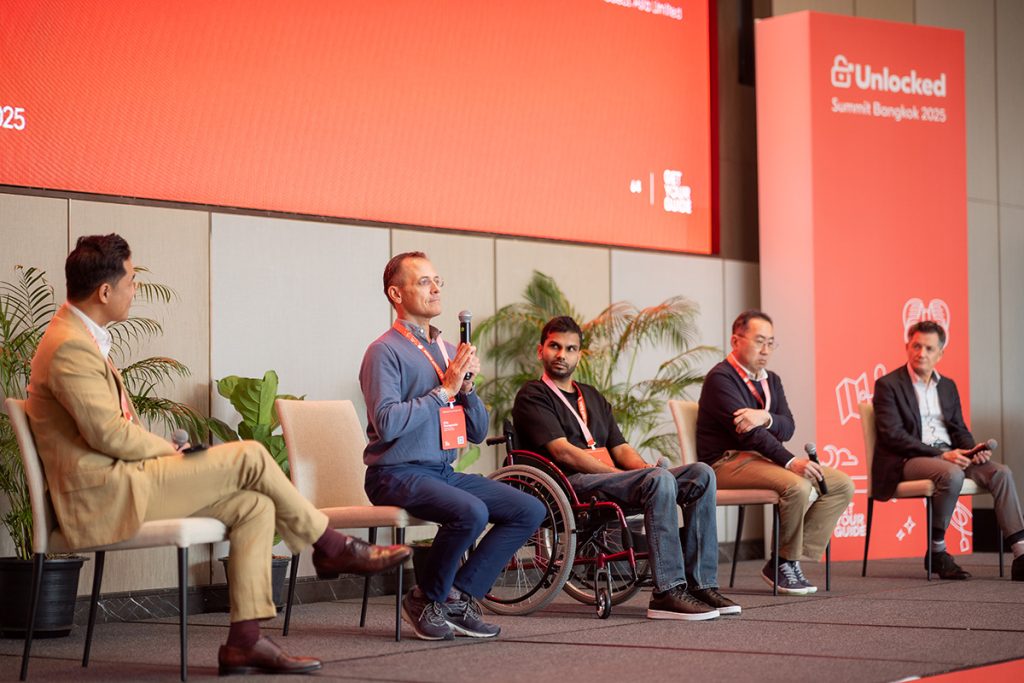
At the GetYourGuide Unlocked Summit in Bangkok last week, a panel gathered to unpack one of the travel industry’s most promising yet complex frontiers – the “Things To Do” sector, the vast constellation of activities, tours, and experiences valued at a $400B+ market.
The conversation brought together leaders from different corners of the ecosystem – from airlines to online travel platforms to global tech enablers and investors.
The panellists were Dinesh Dorai Raj (Regional Head of Stays, AirAsia MOVE), Jun Shin (Head of Travel Business, NOL-Universe), Frederic Barou (SVP Customer Success Management, Amadeus Asia Pacific), and Fritz Demopoulos (GYG Board Member, Queen’s Road Capital and co-founder of Qunar), each offering a different lens on how experiences are reshaping the next generation of travel commerce.
AirAsia MOVE: Where dreams take flight
For AirAsia MOVE’s Dinesh Dorai Raj, the story begins with transformation born of necessity. “When COVID hit and flights were grounded, we had to do everything and anything to stay afloat – from food delivery to ride-hailing,” he recalled. “That’s when we realised that MOVE had to be anchored on travel, beyond the flight.”
MOVE, he explained, is building towards a connected journey, using AirAsia’s vast flight data to anticipate and fulfil every stage of a trip. “We know what people need when they fly – hotels, rides, activities. The challenge is cracking the cross-sell: how do we inspire at the right time, with the right content, without creating noise?”
Dinesh’s vision is to transform MOVE into an inspirational hub, not a mere transactional engine. “When people search ‘things to do in Bangkok,’ they’re already dreaming. We want to be the place where those dreams take shape – through stories, content, and community –before a booking even happens.”
NOL-Universe: Korea’s super-app for travel and play
For Jun Shin, NOL-Universe, born from the merger of Interpark, Triple, and Yanolja’s travel arm, represents Korea’s next evolution in digital travel. “‘Nol’ means ‘Let’s play’ in Korean,” he said. “We’ve brought together travel and live event ticketing – think Expedia meets Ticketmaster.”
As Korea’s outbound market grows amid fierce global competition, Jun emphasised that integration and synergy are key. “Our flight business is booming, but hotels and experiences have lagged behind. We’ve made countless trial-and-error attempts to bridge that gap. Now, we’re seeing higher attachment rates and building momentum.”
NOL-Universe is using Korea’s pop culture power to fuse travel and entertainment. “We’re selling flights and hotels combined with concert tickets – even working with K-pop management agencies to create events abroad,” Jun revealed. “It’s not just about selling a flight. It’s about selling an experience, a story, a reason to go.”
With Korea’s Incheon Airport expanding and new slots opening post–Korean Air-Asiana merger, Jun predicted an outbound boom. “More routes mean lower prices and more travel. Korea’s love of discovering the world will only grow.”
Amadeus: Lessons from 40 years of distribution
While flights and hotels are mature categories, Amadeus’s Frederic Barou offered perspective from the infrastructure side. “Airline distribution took 50 years to standardise. Activities won’t replicate that, they’re far more fragmented,” he said. “There are about 700 airlines in the world, but millions of activities. Each with unique inventory, payment models, and experience types.”
Barou described how the Amadeus Discover platform is bridging that fragmentation. “We aggregate aggregators – bringing content from players like GetYourGuide into the systems of OTAs, airlines, and travel sellers through API integration. We personalise it using Amadeus’s data, so the right activity reaches the right traveller.”
But he cautioned that the sector still lacks personalisation maturity. “When I searched for a Christmas family trip, the site showed me summer activities and wine tours,” he said dryly. “That tells you how far we still have to go.”
Barou also highlighted AI’s double edge. While conversational search and automation create opportunity, they also generate a surge of unproductive “look-to-book” queries. “The challenge is balancing intelligence, reliability, and cost,” he said. “AI can power efficiency — but we must manage the systemic load it brings.”
China’s influence and the power of diversity
Fritz Demopoulos, a veteran entrepreneur and investor in GetYourGuide, brought the conversation to China’s enduring influence. “Anytime you have a market as large as China, you get massive diversity,” he said. “From first-time travellers to multi-generational families, from Tier-1 cities to smaller ones – each segment behaves differently. You can’t treat ‘Chinese travellers’ as one audience.”
He urged operators to localise deeply, from preferences (“offer good Chinese restaurants, allow WeChat and Alipay payments”) to travel style (“they love to talk and interact – don’t overstructure the tour”).
Beyond preferences, Fritz emphasised the power of content and social discovery. “Travel in China is inseparable from content – short video, reviews, sharing moments online. If your product doesn’t fit that, you’re invisible.”
He also offered timeless advice to the industry’s founders: “Culture eats strategy for breakfast. Build a learning culture, a risk-taking culture, and a positive culture. That’s what drives resilience and success.”
AI and the “Golden Zone” of travel
In closing, discussion turned to AI’s transformative impact. For Dinesh, it’s an inevitability — “like the car replacing the horse.” For Jun, it’s a chance to escape the tyranny of metasearch and automate operational drudgery. For Barou, it’s a system challenge – reshaping how agents and APIs communicate.
Fritz framed AI in marketplace terms: “At GetYourGuide, we’re chasing a ‘Golden Zone’ – a balance where both user and supplier win. AI helps us get there by improving discovery, personalisation, and service quality. The key is making the ecosystem healthy for everyone.”


