
INNOVATION breakthroughs in artificial intelligence (AI) and machine learning (ML) may not be directly disrupting the travel industry just yet but they are among the new technologies that could drastically change the way services are delivered in the coming years, say experts at the WiT Singapore 2022 conference.
At the three-day industry event in October, they looked to ever smarter ways for consumers to plan a trip, while pointing out the growing worry of fraud in the digital realm.
While it is easy to spot linear growth, exponential growth in areas such as AI and ML are harder to predict, said Ross Veitch, chief executive and co-founder of online travel agency Wego.
He pointed to rapid developments in computational art, where AI creations have surprised people with their out-of-the-box ideas.
Big changes will also be brought about by cloud computing services, which today come with tools such as AI, so smaller companies do not have to build an entire innovation pipeline to compete, he noted.
By 2030, a lot of products will be personalised for individual consumers, while automated conversational agents will use AI to recognise speech and reply in a synthetised human voice instantly, he added.

From L – R: Johnny Thorsen, Vice President, Strategy & Partnerships, Spotnana. Ross Veitch, CEO & Co-founder Wego. Timothy O’Neil-Dunne, Principal, T2Impact
The “democratisation” of IT tools that used to take large development teams months or even years to create would supercharge innovation in a travel sector that is no stranger to competition, speakers at the WiT conference say.
This will be especially important in a post-pandemic world where consumers are looking for new experiences without any of the unwanted friction they have always dreaded.
Many of tomorrow’s digital systems will be increasingly created by ready-made tools that make coding easy, said Johnny Thorsen, vice president for strategy and partnerships at Spotnana.
“Six lines of code,” he noted, are all that are needed to connect an e-commerce site to various payment systems worldwide today.
At the same time, increasingly intelligent systems will streamline the management corporate trips, from planning to approval, so that there is less manual input involved, he noted.
“Every time someone’s typing manually, it’s a chance for error,” he added. “It’s also wasting time.”
Payment is another area that is fast developing, he noted. Smart contracts, enabled by blockchain technology, for example, could enable people to automatically buy and pay for a ticket at a pre-set price, without any intervention.
Fintech is one big driver for settlements as well, and online travel agencies are finding new ways to enable customers to pay more seamlessly.
At Traveloka, for example, a majority of its Indonesian customer base pay with bank transfers because of low credit card penetration in the country.
Now, buy-now-pay-later (BNPL) options are coming into the equation for customers, who can use it to lock in tickets early with a longer booking window in view, said Alfan Hendro, the Indonesia-based company’s chief operating officer.
“BNPL may overtake credit cards in Indonesia,” he told a discussion panel at WiT 2022.
Payments are also a big agenda item at rival Booking.com, which has a separate financial services setup to manage payments.
That helps to offer payments in a safe and secure way on a global scale, as regulatory frameworks around the world get stricter, said Matthias Schmid, the acting senior vice president for its Trips Division.
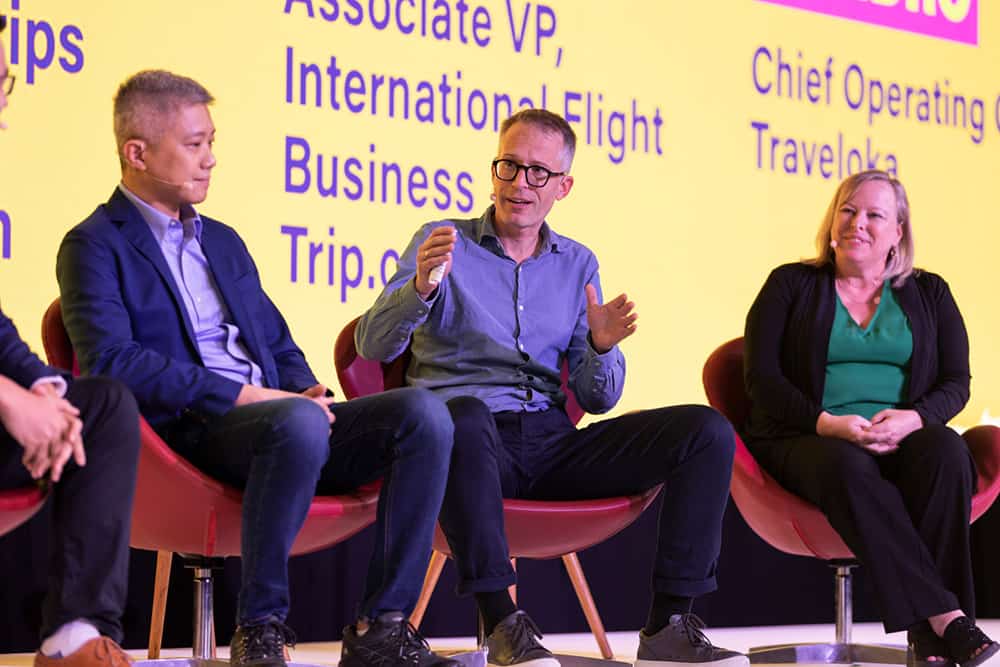
From L – R: Ooi Chee Teong Associate VP, International Flight Business Trip.com. Matthias Schmid Acting Senior Vice President, Trips Division Booking.com. Julie Kyse Vice President, Global Air Partnerships Expedia Group
Indeed, one downside to digitalisation is the spectre of fraud that comes as part of the package. Increasingly, the travel sector needs to find a better way to manage the risks, say experts at the WiT 2022 event.
One way forward could be the use of a sovereign digital ID, said Timothy O’Neil-Dunne, principal at T2Impact.
Doing so could enable consumers to prove digitally to service providers that they are who they say they are, when making transactions online, he noted.
The United States government, for example, is facing an estimated US$45.6 billion in fraudulent Covid-19 unemployment insurance claims, he pointed out.
In other words, fighting fraud would be a constant concern for travel companies, even as they look to create more convenient, sustainable and rewarding travel experiences through digitalisation.
The good news is that more people are expected to travel, now that borders are open again and they are seeking new experiences.
“Travel is a force for good,” said Julie Kyse, vice president for global air partnerships at Expedia Group. “We have missed it… the essence of travel.”
One day, this could mean more than just crossing borders, said Ooi Chee Teong, associate vice president for international flight business at Trip.com.
He envisioned people eventually travelling to space, just like they have taken to flying today. “In future, space is no longer a dream.”