




I asked Wilfred Fan, Chief Commercial Officer of Klook, a question: When a hidden gem is listed on Klook, is it still hidden?
His reply came quick, straight, almost matter-of-fact: “At the moment our team explores them, they are hidden. After review and release, they’re no longer hidden. There’s an expiration date. But that’s not the point. The point is the spirit — to keep looking and keep uncovering.”
Because maybe “hidden” was never the goal. Maybe the point is to keep the spirit of ‘keep looking’ alive — to move the spotlight before a place buckles, to redirect demand where it’s needed, and to make sustainability not an add-on but a flow.
That was the heartbeat of Kreatorverse 2025. Its headline theme was: The Future of Travel is Social. But beneath that was a second, unspoken line: The future of sustainable travel is social too.
Too Many Feet on the Same Street
Governments everywhere face a paradox. They want more tourists — hotels are built, restaurants are waiting, guides are trained — but not all in the same square kilometre.
Wilfred spelled it out: “More and more we’re hearing their concern about over-tourism. They still want tourists to come, because the overall capacity is there. But people are going to the same spots, and it gets congested, while the rest of the city is still waiting to be explored.”
Kyoto’s Gion at cherry blossom season. Bali’s Ubud at yoga hour. Famous, but fragile.
This is where sustainability begins — not with bamboo straws or offsets, but with dispersal. As Wilfred put it, “Running business is about making money, bringing money back to stakeholders. But we also need to look at the environment — and governments in different places are intensely engaged on this.”
Sustainability, then, is twofold: environmental balance and economic return. It’s about spreading demand — dispersing money beyond the square kilometre into cafés, guides, family-run shops and small hotels still waiting to be found. “Travellers are adventurous,” Wilfred added, “and they will research before they go — but only if the content and the connections are there.” That’s the gap social media can bridge, turning overlooked streets into new journeys, and new journeys into livelihoods.
Secondary Cities as First Choice
For years, “secondary city” implied second-best. But the data tells a different story.
“We’ve been looking at destinations that became much more popular over the last 12 months on our platform,” Wilfred said. “Some of them I wasn’t even familiar with myself. But the demand was there. The interest was clear. And when we looked deeper, we saw that these so-called secondary cities are actually becoming the first choice for many travellers.”
Why? Because booking behaviour has flipped.
- Asia Pacific is outgrowing the rest of the world by 12%.
- 91% of travel budgets now go to experiences.
- 40% of travellers make decisions for the next trip within 30 days of their last (Klook Travel Pulse Study)
“It’s much less about where to go,” Wilfred explained. “The first thing that comes to mind is that looks so cool, I wanna do that. Then they decide who to go with, when to go, and everything happens very last minute.”
When “what to do” leads “where to go,” secondary cities can leapfrog capitals. Secondary becomes primary.
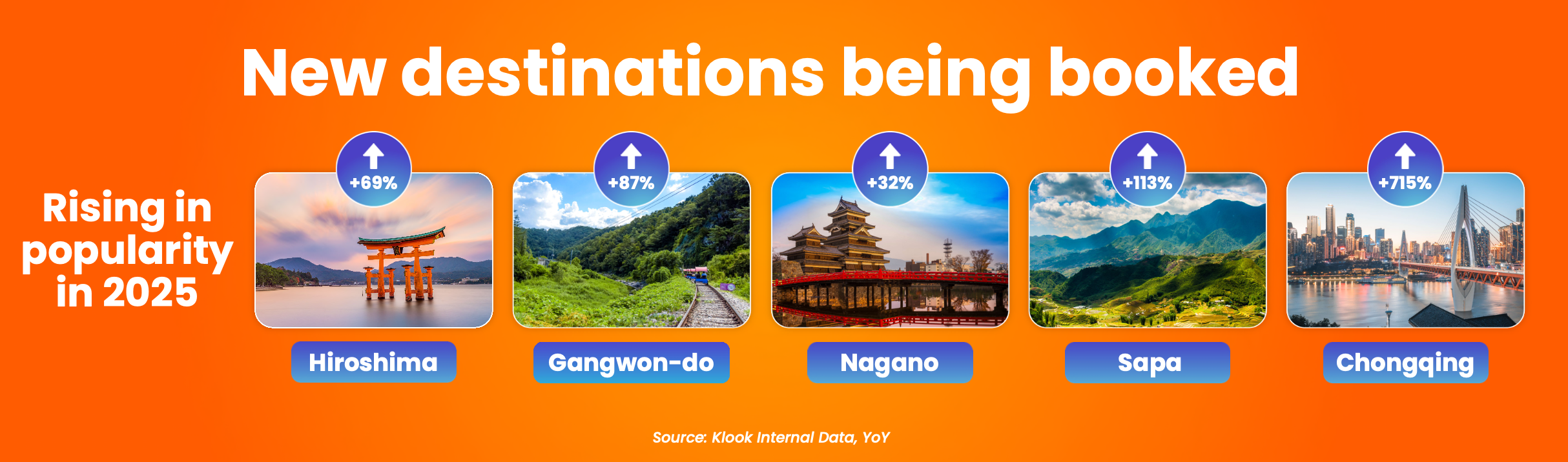
Case Study: Hiroshima
Hiroshima shows how this shift plays out.
For decades, the city was shorthand for one attraction: the Peace Museum. Sobering, vital, unforgettable. But after that, travellers often left with little idea of what else to do.
“They told us very clearly,” Wilfred said. “They want more people to come. They believe Hiroshima has enough substance and value for travellers to spend more time here. But specific spots are congested — especially the Peace Museum. After that, information isn’t easily available. Content isn’t there. That’s the challenge.”
So Klook partnered with the Hiroshima Tourism Association (HIT) to reframe the destination.
- Assemble supply: Miyajima’s floating torii, Setouchi’s art islands (Naoshima, Teshima), riverside activities, neighbourhood tours.
- Productise: bundle them into the Hiroshima Group Pass, mixing icons with underdogs, transport like Shinkansen included.
- Storytell: bring 112 creators to Hiroshima to experience and broadcast.
“Once the content goes up, it has a long lifespan,” Wilfred said. “Sometimes it doesn’t get picked up immediately. But then one day it goes viral, and suddenly everybody wants to do it. We’re raising the probability of that happening.”
But — and here’s the sustainability check — Hiroshima today can’t become Kyoto tomorrow. And both Wilfred and Marcus were clear: dispersal must come with mechanisms to manage flow, not just add volume.
Wilfred put it plainly: “For some players, the Pass is their core business. For us, it’s supplementary — a way to make a destination more attractive so more people will come. When they’re in the location, they’ll go further and explore more, and that benefits the local community. We don’t have to look at every single transaction or only include things that make us money. We have the flexibility to take a long-term view. There’s no guarantee it will make money at the start, but with collaboration it can become popular and deliver value for travellers and partners. We also have the patience to experiment — adding some things, removing others — until it works best for travellers.”

Tiered Playbooks, Not One-Size-Fits-All
“Both strategies have to coexist,” Marcus Yong, Vice President, Global Marketing, Klook said. “We’re not picking one or the other — they have to go hand in hand.”
Tier 1 cities — Tokyo, Rome, Kyoto — sell themselves. The issue isn’t demand, it’s volume. The playbook here is price and convenience: bundles, discounts, skip-the-line passes. “It’s really just about the more you book, the more you save.”
Tier 2 cities — Hiroshima, Sapa — the challenge is the opposite: invisibility. Many travellers don’t know what’s there or how to do it. The playbook shifts to education, content, and itineraries: showing what exists, packaging it into clear starter kits, and using creators to make it aspirational.
The audience is shifting too. Some are travellers who’ve done the capitals. Others are next-gen, skipping big cities altogether for wellness retreats, neighbourhood cafés, and small-scale joy.
Kreatorverse proved the point. Start in Tokyo. End in Osaka. But the soul of the trip? Hiroshima — shrines, riversides, peace museums, turned into stories by creators. Different pain points, different playbooks.
Secondary cities aren’t overflow valves. They’re parallel stages: queues vs curiosity, discounts vs discovery. Dispersal only works when both playbooks run together.
Partnerships That Anchor the Shift

Dispersal only sticks if infrastructure can support it. That’s why partnerships with groups like Hoshino Resorts are essential.
“Hoshino has 50 to 60 properties, many in second- and third-tier locations,” Wilfred said. “From super-luxury Hoshinoya to Risonare to Kai, they cover a wide spectrum. For them, the value we provide is being their social media marketing channel. For us, the value is bringing their remote properties to the forefront.”
In Hiroshima, Hoshino is opening two new properties — one to the east and one to the west, both outside the city centre. Travellers naturally gravitate downtown, so why go further out? But with kreators, they become aspirational.
“We come up with the reasons,” Wilfred said. “Then creators tell them in their own authentic way. That soft-selling message is much more powerful.
And because the partnership is collaborative, the Pass doesn’t just list what’s popular — it includes what the city wants promoted. That’s one of the mechanisms to balance flows.
Social is the Steering Wheel
If Wilfred lays the sustainability foundation, Marcus explains how the steering wheel works.
“4 out of 5 Gen Zs or millennials… are not just influenced by what they see on social media — they’ve actually bought something because of it,” he said. “People today don’t go on Google to search anymore. They go onto TikTok and Instagram.”
Which means dispersal has to be designed through social. The same feed that can clog Shibuya can illuminate Setouchi’s islands. The same creator who sells out one café can pull attention to a countryside trail.
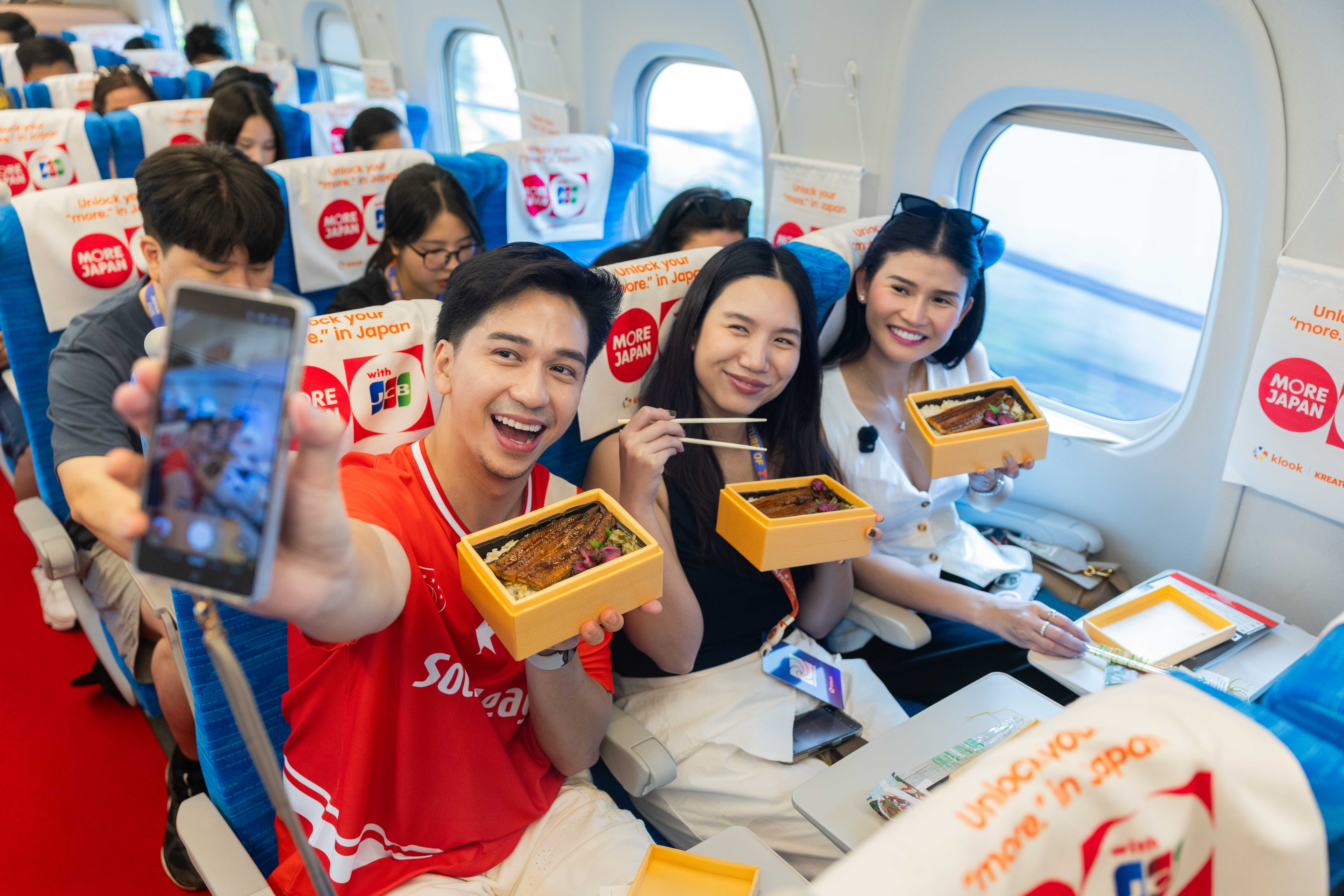
At Kreatorverse, the amazing race felt like a content hackathon for creators. Teams were thrown together across continents, each bringing different strengths — some with a cinematic eye, others with comic timing, others with niche fanbases. The challenge was simple but powerful: explore Hiroshima, capture its attractions, and condense them into content that spoke across borders. In one day of collaboration, the shared social language turned shrines, streets, and museums — even messages of peace — into stories ready to travel the world.
From Scroll to Shop to Cart
“People are on social media to be entertained,” Marcus said. “They’re there to consume content. But once they’re ready to book, the one thing travellers always need is an itinerary.”
That’s the gap Kreator Shops were built to close. Social isn’t just the top of the funnel anymore — it is the journey. As Klook frames it: where social doesn’t just support the journey, it is the journey.

“It’s that magical bridge,” Marcus explained. “I see something on social — oh, this Kreator has gone to Hiroshima and that trip looks amazing. I want to follow that same itinerary or book similar stuff. That’s where the conversion happens.”
Kreator Shops already show up in different formats. Some are straightforward — “five items I booked, book them now.” Others are story-driven — day-by-day reviews, written like a diary. Both formats are live today. But the ambition is bigger. “If I had a magic wand, I’d let people clone the whole trip, add it all to cart, then customise what they like or don’t like. Make it as seamless as possible to check out — and as efficient as possible.”
The lesson is clear: without social, no traffic. Without shops, no conversion. Together, they turn scrolls into strolls — and make creators not just influencers, but full-on travel agents for the next generation.
Loyalty in the Age of Social
Sceptics argue that social commerce only delivers fleeting customers(here today, gone tomorrow travellers). Marcus counters that.
“It’s not mutually exclusive. Social is a great source of new customers. Once they come to Klook, they need a good booking experience. That’s where loyalty kick in. Even as a platinum member, I still go on social to search and be entertained. The flywheel is discovery on social → booking on Klook → back to social.”
That flywheel is what gives secondary cities longevity. A first trip might be sparked by a reel from a creator. A second might be nudged by rewards. Over time, discovery and loyalty loop together, turning one-off curiosity into repeat behaviour.
Creators as Continuity, Not Just Virality
If dispersal is the strategy, creators are the agents. And Marcus stressed: smaller often means stronger.
“The majority of our creators are micro and nano,” he said. “Not by design, but because they deliver continuity. Their stats are often better than mega influencers who only do one-offs. Micros and nanos build relationships, they keep telling stories.”
And that continuity is exactly what sustainability needs. A viral clip can flood a street overnight. But a consistent creator can build literacy — the neighbourhoods, seasonal festivals, crafts that don’t trend but do matter.
That’s why Klook is also investing in creator mentorship. “Instead of us teaching, we let top creators impart wisdom to newer ones,” Marcus said. “They can talk about authenticity, formats, what works in community. That’s how you build not just commerce, but community.”
Trendlets as Nudges
Dispersal doesn’t always need solemn policy. Sometimes, fun works just as well.
Wilfred pointed to the data:
- Dressing up in hanfu in China surged 18x in 2025
- Kimono in Japan, hanbok in Korea remain staples.
- Matcha is the drink of 2024–25.
- Wellness retreats are booming.
Handled right, these are not fads — they’re entry points. A hanfu shoot can bring travellers into quieter districts. A matcha crawl can disperse them across neighbourhoods. A wellness retreat can pull them into rural nature.
The Future of Travel is Social — and Sustainable
Marcus put it best: “Experiences and joy is our product, but community is our growth engine.”
That community — this global wave of Kreators — is what makes the second-city playbook work. They’re not just selling trips. They’re shaping behaviour. They can move demand from bottlenecks into boulevards, spread income across maps, and uncover stories before they disappear.
“The future of travel is social,” Marcus said. And if this new generation of creators embraces the responsibility, the future of travel can also be sustainable.
Hidden gems may have expiry dates. Sustainability doesn’t. The social feed decides where the feet land — and creators hold the map, setting the beat and picking the track, turning scrolls into strolls for the next generation of travellers who live social.


