Jiro Kawakami: “Most people think Las Vegas is a big gaming market but it’s only $8b in annual gaming revenues. Japan’s market is huge.”
It’s been a long time coming but this April, after years and years of waiting, MGM Resorts International received the green light to develop a resort in Osaka, Japan. Actually, calling it a “resort” is an understatement. The mega-project is said to cost a whopping $10b and, when opened in 2029, is expected to attract nearly 20 million visitors annually.
The goal behind projects of such magnitude is fairly simple – to redefine a city on the global stage. For example, the newly unveiled Sphere in Las Vegas that’s already created buzz online. The massive dome projects videos on its circular LED panels and has become an overnight landmark, forever changing Las Vegas’ branding.
Still, the Sphere’s $2.3b budget pales in comparison to MGM Japan’s $10b. But, what will all that budget be used for? Jiro Kawakami, Chief of Staff, MGM Resorts, Japan was on stage at WiT Japan & North Asia 2023 to discuss the upcoming mega-project, as well as how new technology will help MGM realise its ambitions.
Building a resort that will also disperse tourism
This integrated resort, located on the artificial island of Yumeshima in Osaka Bay, is set to become one of the most luxurious and profitable casino resorts ever built.
MGM Resorts, alongside Orix Corporation, spearheads a consortium comprising 20 other Japanese entities, including industry giants like Panasonic, Kansai Electric, and West Japan Railway. The resort will feature 2,500 rooms across two hotel towers, catering to a wide range of visitors, including VIP and super luxury clientele.
The resort will encompass a sprawling area, offering diverse amenities such as 13,000 square meters of meeting space, and 20,000 square meters of exhibition space. Notably, the resort will house a unique tourist-sending facility, acting as a large-scale tourism concierge to promote travel to other parts of Japan, including Kyoto, Nara, and the greater Kansai area.
The long road to secure government support and approval
The decision to develop integrated resorts in Japan aligns with the government’s long-term tourism strategy, said Jiro. The MGM-Orix consortium submitted their plans for the resort in April 2022, which underwent an extensive review by the Government of Japan for nearly a year.
“The examination ran into the Osaka local elections in April 2023 so it naturally became an election issue,” said Jiro. He continued, “In many situations, candidates backing an IR don’t do well when the IR is the main topic of the election. However, polls leading up to elections in April saw over 50% of the citizens of Osaka in favor of the project, so we had an idea what would happen on election day. It turns out, the polls were correct, and the Government of Japan certified our plans to build an IR later that week.”
Profitability and market potential
The resort’s estimated cost of $10b positions it as one of the most expensive projects in MGM Resorts’ portfolio. However, industry experts predict its profitability to be equally remarkable.
“Most people think Las Vegas is a big gaming market but it’s only $8b in annual gaming revenues,” explained Jiro. “Macau is $35b (pre-Covid). Japan’s market is huge. It’s a strong destination with 18 UNESCO World Heritage sites. There are so many things to do outside the IR – if you look at what Marina Bay Sands Singapore has achieved, with such a small market and only one UNESCO World Heritage attraction, it’s unbelievable.”
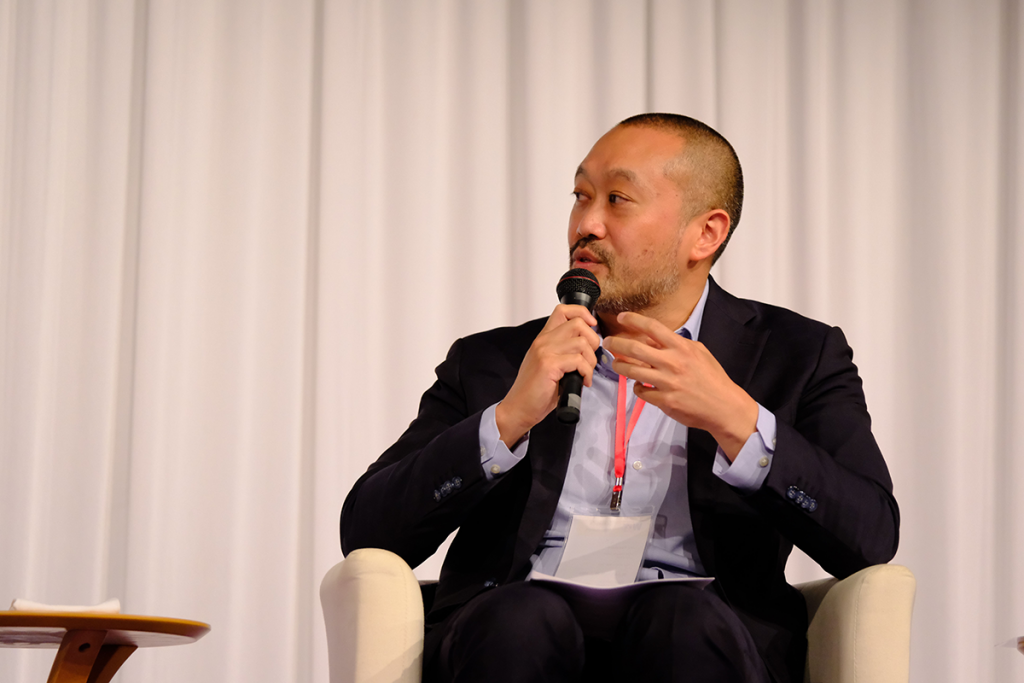
Jiro Kawakami: “Japan’s market is huge. It’s a strong destination with 18 UNESCO World Heritage sites. There are so many things to do outside the IR – if you look at what Marina Bay Sands Singapore has achieved, with such a small market and only one UNESCO World Heritage attraction, it’s unbelievable.”
The resort anticipates an 80% domestic and 20% inbound visitor mix, capitalizing on the 20 million people residing in Osaka, known for their high-capacity spending habits. There will be a charge of 6,000 yen per entry for Japanese, limited to 10 times a month.
MGM Resorts’ experience in Macau, its first resort in Asia, has provided valuable insights for the development of the Osaka resort. Macau’s focus on gaming, where it contributes 90% of total revenues, differs significantly from the multifaceted offerings planned for Osaka. The Osaka resort aims to strike a balance between gaming and non-gaming components, appealing to a wider audience. Additionally, Japanese regulators will not permit junkets so the resort will foster direct relationships with customers, moving away from the traditional junket business prevalent in Macau.
Marketing to the public and to potential employees
With projected employment needs of 15,000 individuals, MGM Resorts acknowledges the talent crunch in the hospitality industry. Jiro said, “The idea of working in hospitality is less attractive now. In Las Vegas, working in an IR is a prestigious job. The industry in Japan needs to do a better job of marketing itself, to speak to universities, and to push towards classroom-style education.”
MGM Resorts’ distribution and marketing strategy has evolved over time, with a recent rebranding of its customer loyalty programme to MGM Rewards. As Jiro elaborates, “We not only look at gaming spend but across all services in all properties so that the ones that don’t gamble get rewarded for coming back. Every dollar you spend is accounted for and you can spend it across all services.”
Additionally, in Japan, MGM Resorts collaborates with partners such as JTB and Kintetsu, leveraging their expertise in the travel industry.
Deciding on new technology for a new resort
“In Japan, there is a big push towards using VR to promote destinations,” says Jiro, adding that MGM has received proposals from VR technology providers and content creators and has found them extremely interesting. However, no official plans on VR or metaverse adoption have been finalised yet.
To be fair, the completion of the resort is still more than half-a-decade away.
Still, Jiro was prompted at the event to imagine what the tourist-sending facility/concierge he spoke about could look like. “I would love to see customers being able to utilize AI to create personalised, customised tours,” he replied, “So you won’t need a lot of encounters with humans – maybe lots of terminals where people can ask, [“I want to eat Unagi, in Nara, and I want counter seating”] … so in that regard, there is a thought to place more emphasis on on AI created content.”
In the spirit of getting creative with Artificial Intelligence, we used Midjourney to create an image of what the tourist-sending facility/concierge at MGM Resorts Japan might look like when it’s finally open to visitors.
I guess you’ll have to check back here in six years to see if Artificial Intelligence got it right.
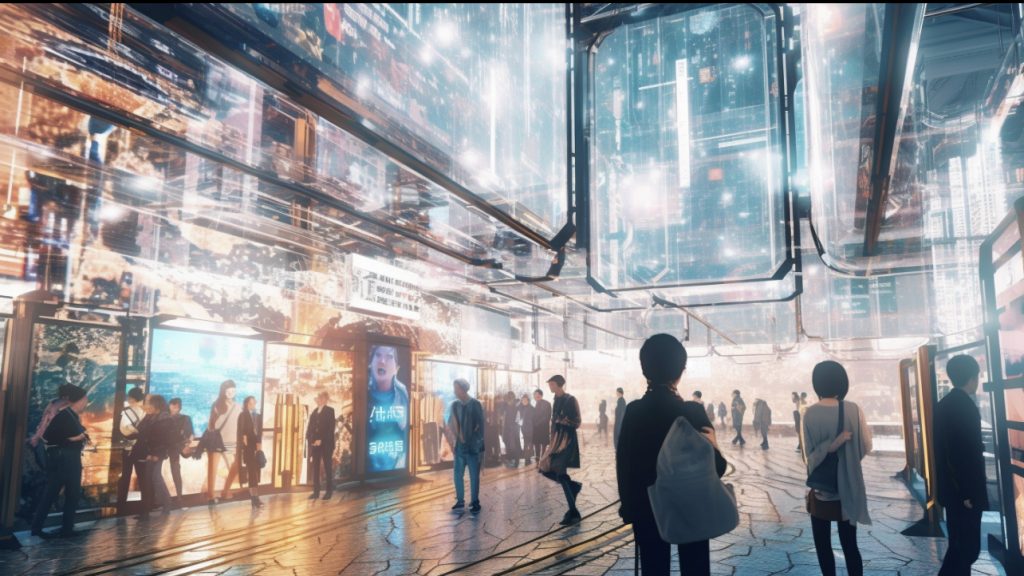
AI creates an image of what the tourist-sending facility/concierge at MGM Resorts Japan could look like.