
In a world where AI is taking care of what and how, possibly the most important question humans can ask is why – why do we do what we do?
That was the first question moderator and WiT founder Yeoh Siew Hoon posed to the three panellists at the Travel Tech Thursdays event in Kuala Lumpur – Ash Raja, co-founder of Small Towns Malaysia; Yock Song Law, founder of Ludus Labs Singapore; and Sophie Mougel, Vice President, Strategy and Regional General Manager, the Philippines and Malaysia, The Ascott Limited.
A small-town boy, a disability advocate and a people person
Ash Raja grew up in Batang Berjuntai, Kuala Selangor, a town most Malaysians have never heard of. That invisibility is exactly what drove him to build Small Towns Malaysia, a platform that has now produced over 170 videos showcasing small towns.
“It’s not about favourite towns,” he said, when pressed. “It’s about what you want to experience, sometimes it’s the nature, sometimes the food, sometimes the diving.”
He doesn’t see Small Towns as an influencer account, more of discovery tool that has demonstrated tangible impact. When their video shone a spotlight on Bundu Tuhan, the town subsequently applied for a government grant using that footage as evidence of its tourism potential, and secured RM1 million from the Sabah government.
Yock Song Law came to travel from a background in a tourism board and tour operating, running unique tours in Singapore. After spending years working with persons with disabilities (PWDs), he kept encountering the same dispiriting assumption: that disability means travel stops. “Why should travel stop because of disability?” he asked.
His answer was Ludus Labs, which wants to make travel possible for PWDs in Singapore. In addition to training PWDs as tour guides, Ludus Labs is also working to create employment opportunities for his community.
Sophie Mougel, who has spent her entire career in hospitality (moving from a small town in France to Australia to Singapore), said, “It’s really about the people. That’s always been the heart of hospitality. My seven-year-old daughter thinks I spent my evenings just typing on a computer, but I love what I do.”
The underserved segment nobody is properly serving
With the theme of “AI & The Aspiring Traveller in ASEAN”, the discussion moved on to address what were the underserved and overlooked markets in the region.
Yock Song laid out what the disability travel market actually looks like. It is not, as many assume, simply about wheelchair users. It encompasses people with visual and hearing impairments, those on the neurodivergent spectrum, and critically the world’s rapidly aging population. With 1.3 billion people globally aged 60 and over, representing one in six of the world’s population, the scale is massive.

Ash Raja, creator of Small Towns Malaysia: “It’s not about favourite towns. It’s about what you want to experience, sometimes it’s the nature, sometimes the food, sometimes the diving.”
More importantly, this segment spends. “They don’t travel alone,” Yock Song pointed out. “They travel with companions, with family. The average group size is four to six – effectively a private tour group.” That multiplier effect means the value of each PWD traveller extends well beyond the individual booking.
Ascott has taken this seriously. Sophie described its playbook on disability and inclusion, developed in partnership with Valuable 500, which goes beyond ramps and wider corridors. It covers quiet corners for neurodivergent guests, QR codes for those with hearing impairments, and specific staff training.
“We are on track to have 100% of our frontline staff trained on disability awareness,” she said. “But it goes beyond compliance. It’s about recognition, seeing someone who needs a different kind of experience, and actually knowing what to do.”
The gap, as Yock Song framed it, is fundamentally one of trust and information. “There is no trustable source of accessible travel information,” he said bluntly. “You can show beautiful places, but it doesn’t answer the questions a PWD needs answered: how do I get there, and when I arrive, can I actually enjoy it?”
Worse, when people turn to AI tools for answers, the results often hallucinate, producing confident but inaccurate information about accessibility. “The content isn’t in the LLMs,” he noted. “Or at least, it’s not accurate.”
Content, authenticity, and the art of giving something away
The conversation turned to how brands and creators generate demand and the consensus was clear: authenticity is not a strategy, it’s a prerequisite.
Ash Raja’s view on this was direct. “It all starts with intention. If you’re just trying to make a sale, your audience can feel it. You’re not giving anything. Ask yourself: why should I watch this? What will I get from it, knowledge, entertainment, nostalgia, a feeling?”
He warned that purely product-led content might produce occasional viral moments, but won’t build a brand. “You need to think about what your viewer walks away with from every single video.”
Sophie described Ascott’s approach as co-creation: “We invite content creators into the property, and we build something together. It’s not a transaction. We want to be part of the community, and the community to be part of us.” From there, the funnel builds – tags, campaigns, booking incentives – but the foundation has to be human.
The panel got into a debate about whether content creation should sit inside a dedicated department or be distributed across an organisation. Ash argued for structure and direction; Yock Song offered a more nuanced point: “Not everyone can create, but everyone can contribute.”
Small Towns Malaysia, notably, has a visually impaired copywriter and translator on the team — completely blind, he translates all the captions and descriptions for the videos by listening.
Ash shared that listening to the video descriptions had moved this colleague deeply. “He said, ‘I thought I would never be able to experience these places. But I want to go. I want to hear them. I want to feel the difference.”
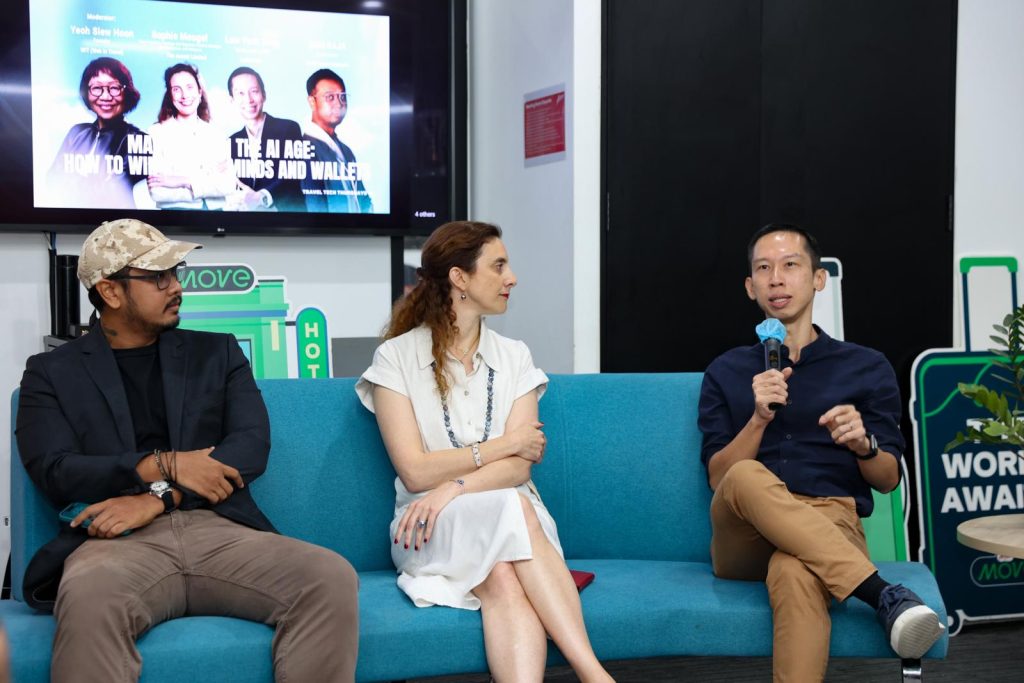
Yock Song: “There is no trustable source of accessible travel information. You can show beautiful places, but it doesn’t answer the questions a PWD needs answered: how do I get there, and when I arrive, can I actually enjoy it?”
AI as tool, not oracle
Several concrete uses of AI emerged – some already in practice, some aspirational – when panellists were asked to cite examples of “tech for good”.
Ash uses AI for research, scheduling, and what he described as “leaking data” from his video archive: extracting patterns from comments and engagement numbers to understand what makes each town distinctive and which traveller profile is likely to love it. “AI will tell you things you didn’t expect,” he said. “Either you get on board or you get left behind but it’s a tool.”
Sophie pointed to Ascott’s development of motion sensors for their senior living and wellness brands, technology that detects falls and automatically alerts staff, potentially saving lives.
Yock Song’s wish was elegantly practical: a wheelchair mode on Google Maps. “Right now, you can drive, walk, cycle. You can’t navigate as a wheelchair user. If that one function existed as a default, it would change last-mile accessibility planning enormously.”
He noted that Grab, through its delivery network using mobility devices, has quietly built some of the best accessible-route mapping in Singapore, a byproduct of their core business that has real utility for PWD navigation.
The panel also heard about VoiceMaps, the global audio tour platform, and a story of a veteran Dutch tour guide who suffered a stroke and lost his ability to speak, and who was able to continue guiding through an AI voice clone built from recordings of his original voice. His tours now live on, in both English and Dutch.
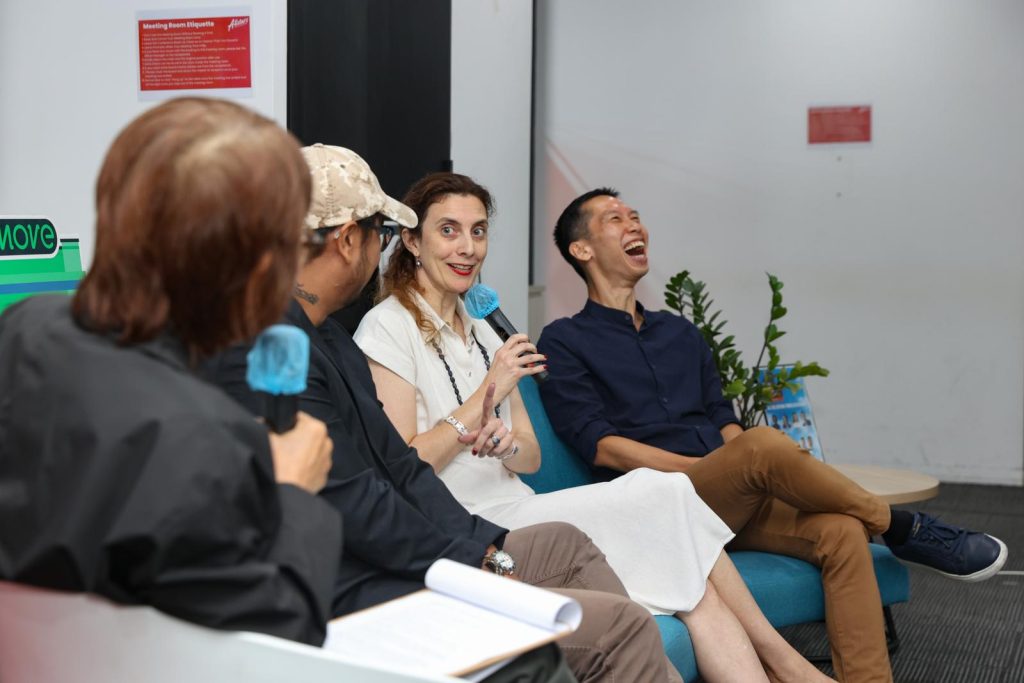
Sophie Mougel: “We are on track to have 100% of our frontline staff trained on disability awareness. But it goes beyond compliance. It’s about recognition, seeing someone who needs a different kind of experience, and actually knowing what to do.”
The opportunity: Slow, deliberate, underserved
Closing the panel, the discussion converged on what the aspiring traveller in ASEAN actually wants right now.
Three themes emerged:
Remote and slow. People are gravitating toward destinations where the place itself is the experience. Slow travel – embedding in a community, communicating with locals, becoming temporarily part of somewhere – is no longer niche. It’s a growing demand signal.
Digital detox. Retreats that explicitly take guests off their phones for days at a time are gaining traction. The product of disconnection is becoming a luxury.
Machine-readable content. Sophie’s final, practical point: “Make sure your content is machine-readable. We are moving into an era where algorithms make the choices. If your destination isn’t findable, it doesn’t exist.”
She tested this herself, searching for retreats in South-east Asia on Perplexity, and found the content sparse and poor. The opportunity for destinations and smaller brands is to fill that gap now, before others do.
“Let’s go find the green shoots and grow them ourselves,” Siew Hoon concluded.
The underserved segments – PWDs, aging travellers, small-town curious, slow travel seekers – are not waiting for the industry to discover them. They’re already aspiring. The question is whether the industry will build to meet those aspirations.