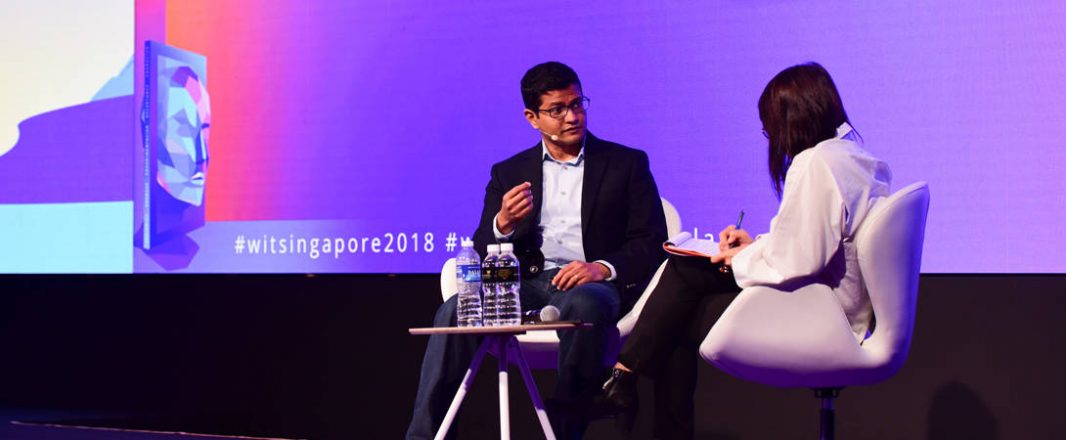
When asked to pick a song that best describes his personal journey with Facebook, its head of global travel strategy Nikhilesh Ponde, chose “Whatever It Takes” by Imagine Dragons.
“Whatever it takes, ’cause I love the adrenaline in my veins/I do whatever it takes ’cause I love how it feels when I break the chains”, goes the song.
After listening to Ponde’s chat on the WiT Singapore 2018 stage, it was easy to see why that song would have been appropriate. As rapidly as technology is evolving and as quickly as market demands are morphing, there is clearly adrenalin flowing through Facebook’s strategic and development teams.
It is also understandable that Facebook would have hired an executive with specific interest and experience in Asia to head its global strategy. Asia, after all, has become the region that initiates trends and moves markers and brings to the global market at large key learning points.
“Asia forces us to think outside of the box, and the learnings we get here help us improve our products across the board,” said Ponde.
To illustrate the point, Ponde brings up Indian telco Jio. It launched a sub-$30 4G mobile device with smart features about six months ago and has since sold 30 to 40 million phones.
“We have this unique combination of millions of people coming online on very low-end  devices in local languages, and that creates so many unique challenges for a global company like Facebook,” said Ponde (pictured right).
Understanding the market, especially new emerging ones, and finding the right product market fit is critical. This is a lesson Ponde learnt in his days at Flipkart and Expedia that he now brings to the Facebook team.
“Flipkart was initially a western business model grafted onto the Indian market. But the moment they introduced cash on delivery in India in 2012, found the product market fit, the growth just took off in the next several years,” said Ponde.
Ponde said his experiences both at Expedia and Flipkart have taught him “to think about the customer and design for the customer”.
Having global reach and ownership of big data (2.2 billion people use Facebook every month; 1.5 billion use Facebook daily) affords Facebook a lot of information about its customers.
For one, it knows that videos have quickly become the preferred way both brands and consumers are creating and sharing content. In 2020, 78% of all mobile data traffic worldwide will come from video. And videos in short form (less than five seconds) get the best engagement.
It also knows this: on average, travellers in Asia spend three hours every day on their mobile phones and predominantly on platforms like social and messaging.
The customer data cache is driving development and design. “We try to serve everyone mainly through our global platforms – Facebook, Messenger, Whatsapp – but we are also investing in apps like Facebook Lite to make sure our products and services are accessible and available on every kind of mobile phone…we are definitely designing for specific markets,” reiterated Ponde.
Conversational commerce is another development that has “bubbled from small businesses in Asia” and is influencing Facebook’s development strategies.
“We really saw this happening first in countries like India, Thailand where local shopkeepers would use messaging apps not just to connect with customers but also to run their businesses – take orders, inform them about availability, give delivery notices. This was a completely new type of behaviour that we had never seen before, and we had not anticipated. So now, we are rolling out new features and enhancements to these platforms like the Whatsapp business app to enable these small merchants to more effectively manage their business.”
Ponde offered that Facebook is “running some tests” to figure out the right user experience with regards to payment, something that is more difficult to implement due to differing financial regulations with which it has to comply. “But we will make strides on it”.
Where does this leave small businesses that don’t own big data that is the building block for personalisation and “designing for the customer”? How do they start?
“The data exchange should be what’s relevant to the user. So obviously you have to have a CRM database that you can service the customer. Whatever data is relevant to run the business will help improve the person’s experience at the end of the day, that’s what you need,” said Ponde.

Credit: KLM
Enhancing the user experience is also what drives businesses like Facebook to utilise technology like augmented or virtual reality, the next step from videos, said Ponde. He describes KLM’s recent launch of an augmented reality feature on Messenger allowing its customers to size their cabin bags to make sure it fits in the cabins’ overhead compartments as a “great example of customer-centric innovation – applying new technology to a problem that people have”.
Up Facebook’s sleeves is an upgraded version of Oculus, which he said would be transformational for travel. Called Oculus West, the new VR gear to be launched next year, will be fully self-contained, have room detecting capabilities and six degrees of freedom. Once worn, wearers will be immersed in a 360-degree VR environment that will adapt to them as they move around.
“That will be a gamechanger in terms of people’s perception of what VR as a technology is capable of in terms of giving them a fully immersive experience,” said Ponde.