
In a year in which Disney, the world’s most iconic theme park brand, celebrated its 100th birthday, and Taylor Swift, its most iconic pop star broke records galore with her colossal world tour, it would seem like a stretch for those in the travel and experiences business to feel anything but optimistic about their business.
When it comes to producing fun at scale, humanity has been peaking recently – as Bono of rock legends U2 reminded us as he praised the new Sphere project in Las Vegas, Nevada for its eye-popping “grand madness”. And while dark news bulletins talk of new war zones elsewhere, there are surely worse jobs around than boosting the world’s fun factor.
At WiT Singapore 2023, an action-centric panel gathered to pore over ‘The Human-ness of Travel & Experiences’, enjoying the fact that new over-heated headlines have quickly moved an industry far further from the talk of border closures and global lockdowns that we had during the pandemic.
Back with a vengeance
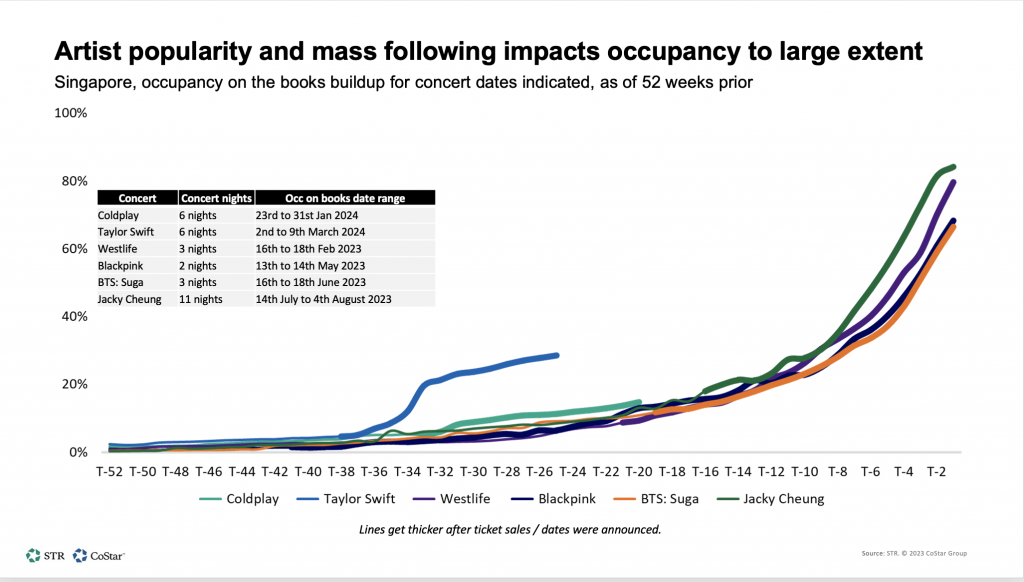
Earlier this year, legions of Taylor Swift fans fought tooth and nail for a seemingly rare chance to join in one of six nights in March 2024 when the pop princess plays six nights at Singapore’s National Stadium, the only Asia stop on her Eras tour – already heralded as the biggest tour of all time less than halfway through its run. (This STR and CoStar chart tracks the impact of the different music concerts on hotel occupancies in Singapore, with Taylor Swift a clear outlier in its early, forward booking impact.)
“What’s more human than live music and the return of events after Covid,” asks Sarah Wan, General Manager, Indonesia, Malaysia & Singapore, for Klook. Wan was one of those enjoying the current boom in music tourism, including frenzied waves of excitement over securing tickets for the shows – given that Klook is the official experience partner for the Taylor Swift tour. “That’s where we bundled together for the first time, Taylor Swift concert tickets together with hotels as the entire experience package.
“Technology is really an enabler for this,” she reminded the crowd. “I think one of the things that we focused a lot on was making sure that the tech experience was seamless for the customer. And we were very thankful to share that we were one of the platforms globally that didn’t crash.”
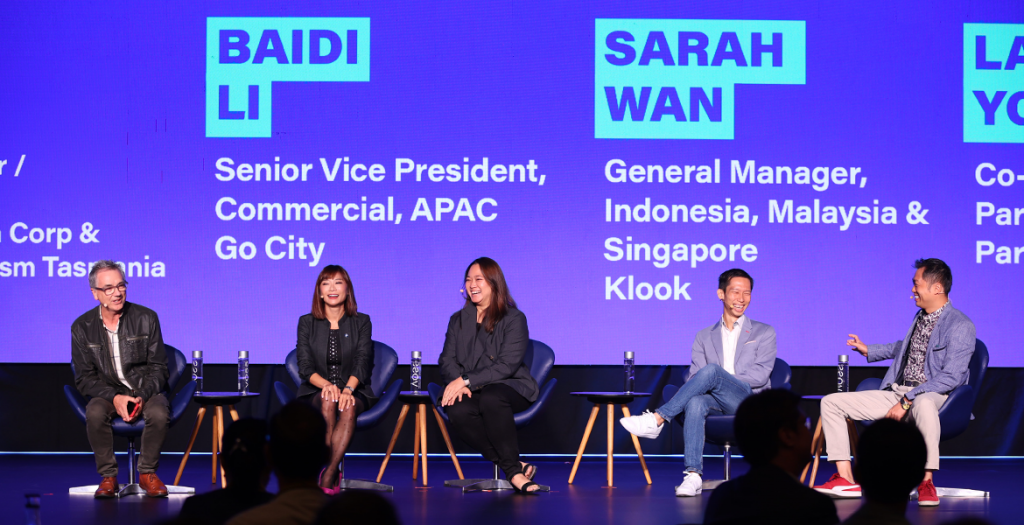
From left: Rod Cuthbert, Baidi Li, Sarah Wan, Yock Song Law and Chan Chee Chong: Addressing how tech can be used to enrich the in-destination experience for travellers, from wayfinding, to personalised itineraries, to immersive storytelling and inclusivity.
AI can make travel personal and immersive
While many see the personal touch as the big draw for ground-based experiences, as our planet’s weather becomes less predictable, fast and effective use of data could be a life-saver for customers and travel businesses alike.
Baidi Li, Senior Vice President, Commercial, APAC, Go City, says combining personal preference data algorithms with and AI can help companies like hers to flex for fast-changing travel needs. “We’re hoping to come up with some personalisation-based itineraries in real-time,” she says. “If today is a rainy day, don’t go to an outdoor concert, go to a museum instead. If today is a beautiful day, go for kayaking in the mangroves. This ability will really help people to enrich their experiences of each moment, while they’re on the road.”

Klook’s Sarah Wan on bundling Taylor Swift concert with a hotel stay: “I think one of the things that we focused a lot on was making sure that the tech experience was seamless for the customer.”
As a perfect example of tech-driven human-ness on display, Li sites a recent experience of ‘The New World’s End’, in Singapore’s Little India, available on Go City. Introduced to her by WiT’s Yeoh Siew Hoon, it was a thrilling surprise.
“It’s a fully immersive audio experience of Little India, bringing you back to the 1920’s,” she says. “It’s a tragic love story of a man called Kiran and a woman named Rosa. And it has a really good use of geolocation technology and augmented reality – you use your own footsteps to trigger the story, while enjoying the buzz of lights and crowds of people, together with the smell the spices and the aromas of cooking smells. This is the beginning of Singapore bringing its arts to the streets. It’s a wonderful experience, and a great use of technology.”
Focus on storytelling
Yet for such experiences to really work, the key component should not hinge around an unstable platform. “As a tech player my advice is always don’t focus on tech,” warns Chan Chee Chong, CEO & Co-founder of GlobalTix. “Focus on the storytelling, focus on the customers.” Too often, if new tech-driven features fail, their inaction generates more pain than gain to customers and frontliners alike, he notes.
Indeed, high-capacity experiences provide a perfect example of how well-appointed technology can be integrated with great human talent. Yock Song Law, Co-founder of Tribe Tours, Singapore, says technology like interactive goggles and AI-driven personalisation can better enable big groups to explore busy museums, with less disruption to other guests – yet with human guides helping the group enhance their own personal adventures.

Go City’s Baidi Li: “We’re hoping to come up with some personalisation-based itineraries in real-time.”
“It’s as if everyone has their own personal guide: yet at the same time, your main guide is able to manage multiple groups of people. That’s how technology and humans can weave together, to tell that story.”
Freeing up humans from the mundane
In an often crowded and time-poor environment, AI does deliver the promise of spreading knowledge effectively. “We’re looking into how AI can answer fundamental customer questions, so that humans then focus on the more difficult scenarios,” says Wan from Klook. “I don’t think it will ever be a direct replacement: you will always need humans to better understand the true customer pain points and problems. When it comes to creation of experiences, we’re seeing a lot of integration of tech with art.”
Wan sees tech-immersive experiences such as the Vincent Van Gogh experience at Resorts World Sentosa as the perfect marrying of technology lifting the human experience. “You see art pieces come to life, and you can use tech to make the most beautiful experiences. Yet when it comes to human traffic, and the control of how many people go through the exhibition, that always needs to be human-planned,” says Wan. “There needs to be a marrying of technology and our human nature, to create better experiences.”
Creating new jobs and enabling inclusive travel
Disruptive technologies like AI should over time give as much as they take in terms of the jobs market, asserts Go City’s Li. “I think AI is definitely going to kill a lot of jobs. That’s a hard fact: a lot of those kind of repetitive jobs that can be automated, will be gone. But it will also create a lot of new jobs for us,” she says.
“I think AI can really help us to level the playing field, and help more people who are really passionate about creating memorable experiences, with their own personal touch, to go out and introduce their experiences to the wide world.”
Rod Cuthbert, founder and former CEO of Viator, asked the panel whether technology could better enable the industry to manage its peak-season crush. “Take Dubrovnik, Barcelona and San Sebastian: there’s a whole lot of places you just don’t want to be from June to August. It’s just too crowded. And the Chinese market isn’t even there yet.”
Tribe’s Law believes the carrying-capacity challenge will come down to a need for more collaborative data. “If everyone opens up a platform and shares it, you’re going to have global data indicating the best and worst times to travel. Currently, we’re not doing that: every OTA has their own comfort zone and they’re not willing to open up. Once those issues are broken down, we can do better.”
Inclusivity is also a key consideration in improving the ground experience. Chan of GlobalTix says that destinations like Singapore are currently working hard to become more inclusive and accessible experiences to those travellers with disabilities. And that means training a wider number of guides.
Tribe, for example, runs tours of Singapore’s Enabling Village, guided by People With Disabilities, the first Singapore tour company to do this. Law talked about how wayfinding could be made easier for people with disabilities. “Travel can be more inclusive for people with disabilities when we make wayfinding easier. By empowering PWDs to provide firsthand data on accessibility, we can feed open maps platforms like Google with the information they need to help everyone navigate the world with confidence.”
Adds Chan, “We need to look at having more positive visibility: having someone who has these challenges guiding you and sharing their stories. It again comes back to the human touch – thanks to that new perspective, suddenly this world comes alive for you, as people gain a richer appreciation of people’s shared humanity.”