


It seems like you can’t go 30-minutes these days without hearing talk of Artificial Intelligence or seeing AI-related posts on social media – and for good reason. AI, now dubbed “the new internet”, “the biggest paradigm shift since the iPhone”, and “our future overlord”, has advanced at breakneck speed since ChatGPT made its debut nearly a year ago.
I recently watched a movie called “The Creator” – it’s about a dystopian future in which humans and AI are at war with one another. The film’s director, Gareth Edwards, said he was inspired by many sci-fi icons of the past like 1982’s Blade Runner, yet another movie in which humans are at odds with a manufactured form of intelligence.
“Does AI speak in a loud voice, or is it monotone like the sci-fi movies?” asked Fritz Demopoulos, CEO, Queen’s Road Capital, in the opening line of his session at WiT Singapore. It’s funny because that’s a great question to ask yourself when watching The Creator. While the movie checks all the boxes of a solid Hollywood blockbuster – great visuals filmed on location in Thailand and parts of Southeast Asia, a terrific score by Hans Zimmer, and a high-octane plot that validates the overly priced popcorn – it lacks the complexity around AI discussions in real life.
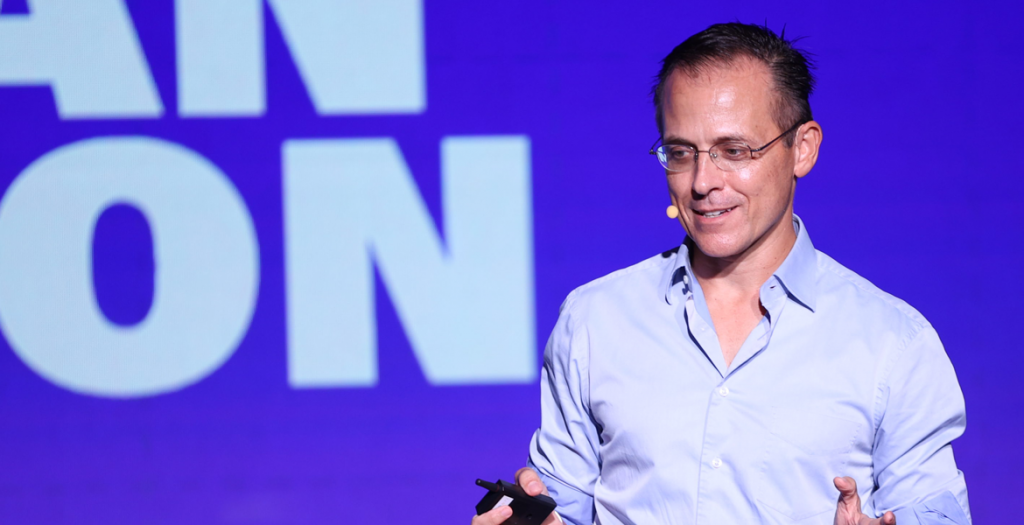
“No doubt there are many benefits [to AI]. But do we really want to live in an overoptimised world, enabled by an AI bot, controlled by a few companies in Northern California?” questioned Fritz Demopoulos at WiT Singapore
In movies and TV shows, AI is an archetype. A trope. It takes the form of humanoid robots or cyborgs. Hal 9000 (2001: A Space Odyssey), arguably the most infamous AI character in pop culture, made the monotonous AI voice legendary. And like Hal 9000, many AI-based characters challenge humanity with brute force – either physically, mentally or emotionally -forcing us to adapt, accept, or retaliate against the rapidly evolving species.
AI in real life may not be as dramatic (yet?), but the questions surrounding its use are far more nuanced.
“Elevators make it easy, but many health nuts will still take the stairs,” continued Fritz. “Processed foods are convenient, but many prefer home-cooked meals and natural ingredients – in spite of the inconvenience.”
Fritz kept stacking the analogies with, “Has anyone been to Denmark recently? Despite being a wealthy country, the Danes embrace their cycling culture” and “Many medicines are helpful but taking them more judiciously might be a better bet.”
The message was clear; like all great inventions, AI has the power to empower or diminish, build or break, create or destroy – and it all depends on how we choose to use it.
If you put your ear to the ground during events like WiT Singapore or any gathering of techies, you’ll notice that the conversations hardly veer into anything as dramatic as The Creator or Blade Runner or Ex Machina would have you believe. The closest you’ll get to pop culture’s version of AI are comparisons to something like Her, a film in which a lonely man falls in love with his computer’s operating system. The “future” in that movie is also clinically ordinary; nothing remotely dystopian about it.
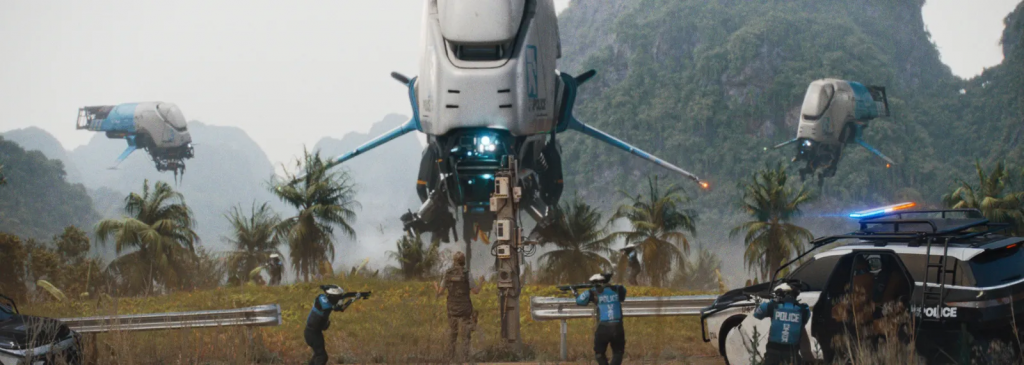
High-octane action scenes from The Creator (2023), a film about humans and AI at war with one another. Image credit: 20th Century Studios
In fact, a movie like The Social Network, an exaggerated retelling of Facebook’s origins, is more representative of the AI discourse in 2023. Like Facebook and social media, those in-the-know are more afraid of AI having a quiet yet significant, irreversible impact on society as a whole… and most of us wouldn’t even be aware of it.
For example, take photography and art and how they relate to marketing. On the subject of AI-generated images of happy customers, Baidi Li, Senior Vice President, Commercial, APAC, Go City, said she wouldn’t use AI-generated images of humans because the eyes were always void of emotion. They lacked a certain spark. “That cannot be replaced by AI and its current technology”, emphasised Baidi. “I would encourage all operators out there to still provide a memorable experience with that personal [human] touch.”
It’s a great point, and not to mimic Fritz Demopoulos’ analogies but isn’t that why professional photographers still carry around bulky DSLRs and bags full of lenses despite having sleek iPhone 15s with state-of-the-art cameras in their pockets? On the flipside, don’t “phone photographers” also boast tens of millions of followers on their socials, rivaling the number of megapixels in whatever device they’re using?
It’s safe to say that the true side-effects of AI aren’t apocalypses or human-machine wars, they’re more intimate… slowly but subtly changing our nature as people, for better or worse. “I think the biggest risk of AI is actually conformity”, said Fritz on stage. “We’re all going to be the same… wouldn’t that be horrible?”
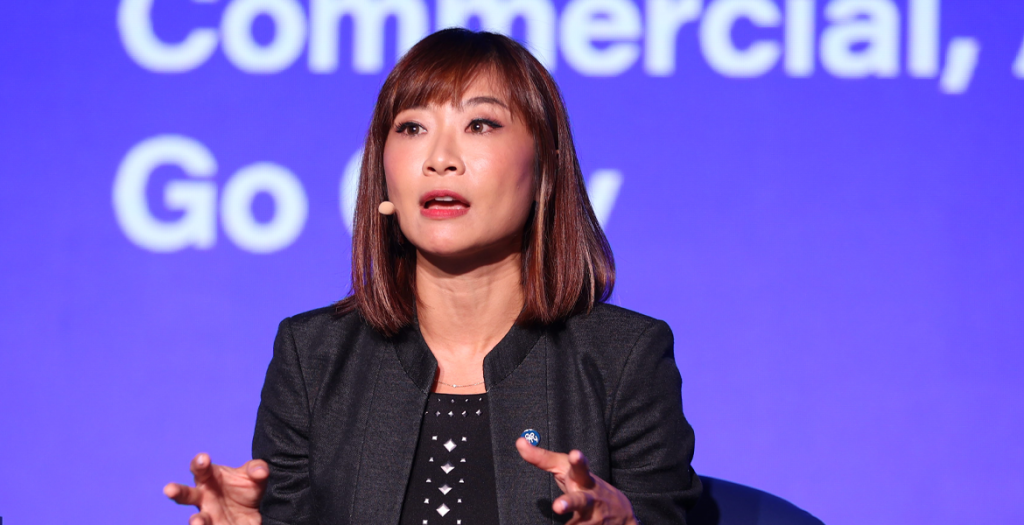
Baidi Li, Senior Vice President, Commercial, APAC, Go City: “I would encourage all operators out there to still provide a memorable experience with that personal [human] touch.”
“No doubt there are many benefits [to AI]. But do we really want to live in an overoptimised world, enabled by an AI bot, controlled by a few companies in Northern California?” questioned Fritz.
Speaking on the different experiences various social demographics will have with AI, Fritz didn’t mince words when he said, “Sometimes, we have no problem living in an overoptimised world that might be unequal from an access point of view, although those services are efficiently delivered. That’s where we are in the travel industry today. Airlines are efficient, but not everyone gets to sit in first class.
“In spite of AI’s capabilities growing dramatically, our knowledge of its impact on us as people is also going to grow dramatically.”
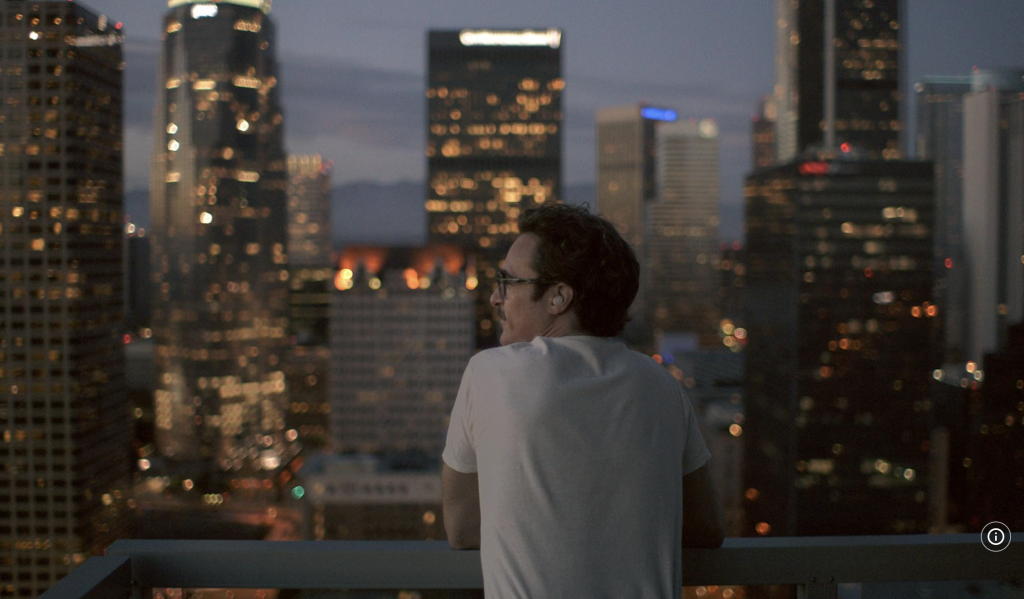
The world in Her (2013) is driven by AI but not remotely dystopian or apocalyptic. Image credit: Warner Bros Pictures
All of this to say, unlike the movies, paradigm shifts in the real world rarely come with easy ultimatums such as “bow down to AI or it will destroy you” or “stop using AI before the singularity wipes out the human race”.
Listening to the sessions at WiT Singapore, it’s quite clear that AI implementation (or “infiltration” depending on your side of the fence) in the real world isn’t devoid of choice. That’s the keyword – choice. No one’s forcing us to adopt AI, robots aren’t pushing humanity into extinction, the technological world isn’t leaving us behind by design. Quite the opposite – the only way the Age of AI happens is if everyone adopts it freely.
No one makes us binge on Instagram Reels.
But, like fast food, cars, elevators, modern medicine, the Internet, social media, Online Travel Agencies and smartphones, we’ll most likely adopt AI in our daily lives all on our own – running in the background of our favorite apps and used for content creation by everyday household companies, including major Hollywood studios.
So, maybe the answer to the question “Does AI speak in a loud voice or is it monotone like the sci-fi movies?” is in the form of another question – “Do you think AI will speak softly, confidently and however we want it to?” That’s its greatest feat of all. Armageddon not required.
Fundamentally, it’ll change the way humans, well… “human”.


